

The Emotion Lifecycle: An Acceptance-Based Self-as-Context Exercise
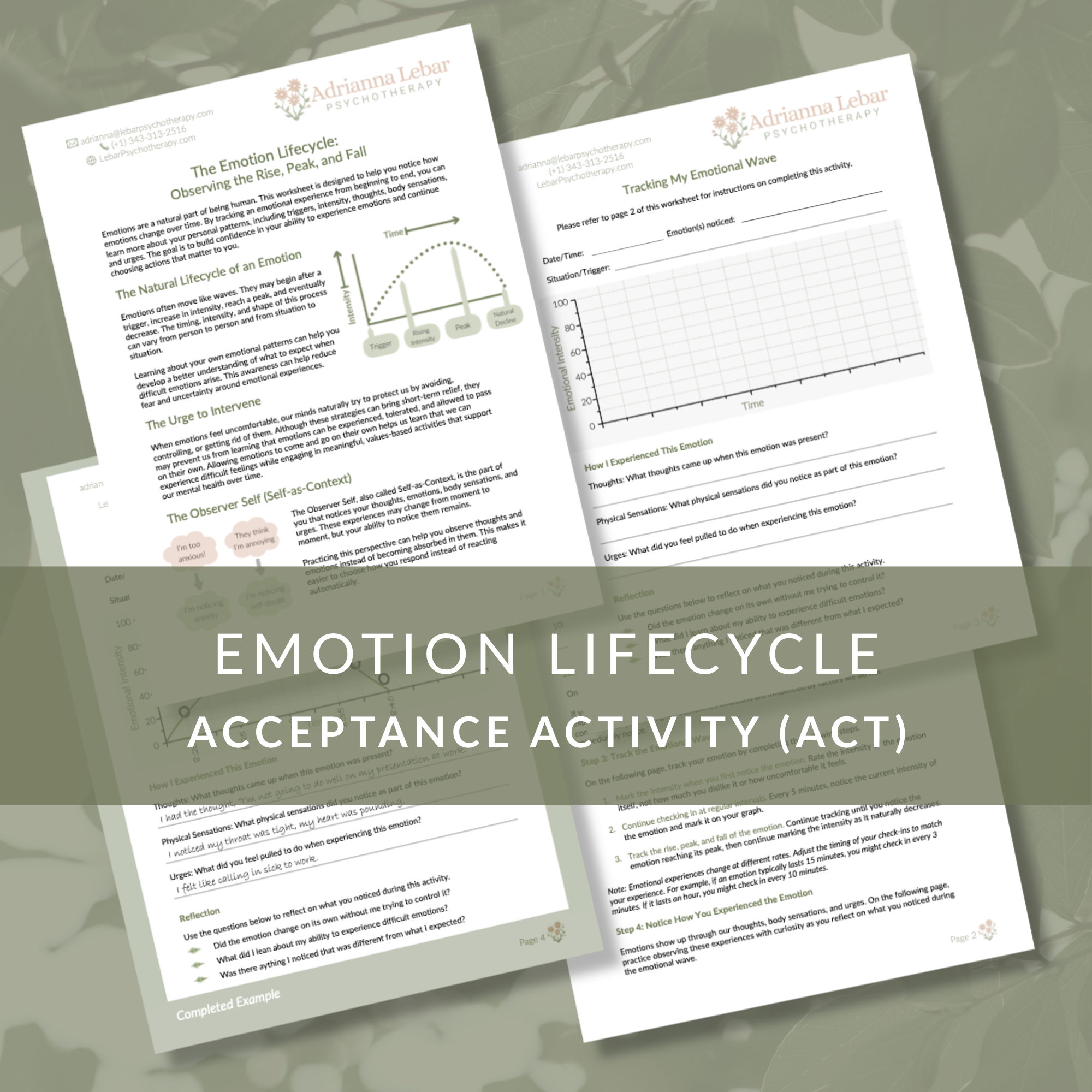
A printable resource for observing an emotional experience over time and practicing a self-as-context perspective.
The Emotion Lifecycle worksheet is an acceptance-based exercise informed by Acceptance and Commitment Therapy (ACT). It provides a structured way to observe an emotion as it changes over time, while also noticing the thoughts, physical sensations, and urges that accompany it.
This exercise draws on two ideas from Acceptance and Commitment Therapy (ACT): acceptance and self-as-context. It provides an opportunity to observe an emotion as it changes over time, while noticing the thoughts, physical sensations, and urges that accompany it. By practicing this kind of observation, the exercise introduces the idea that an emotional experience can be noticed without needing to immediately act on it or change it.
What Is Self-as-Context?
Self-as-context is an ACT concept that refers to the perspective from which internal experiences can be noticed. Thoughts, emotions, memories, physical sensations, and urges can change from one moment to the next. Although these experiences change, they can continue to be noticed from the same observing perspective.
For example, someone might notice the thought, “I can't handle this,” along with a racing heart and an urge to leave the situation. Self-as-context involves noticing each of these experiences as they occur. The thought can be recognized as a thought, the physical sensations as sensations, and the urge as an urge.
This perspective can be useful when an emotional experience feels all-encompassing. Practicing observation creates an opportunity to notice what is happening internally without needing to immediately respond to every thought, feeling, or urge. The Emotion Lifecycle worksheet provides a structured way to practice this perspective while tracking how an emotional experience changes over time.
Why Track an Emotion Over Time?
Emotions can feel fixed when we focus primarily on how uncomfortable they are in the moment. Observing an emotion at several points can provide perspective on how it changes and develops, helping you better understand the experience without needing to analyze or change it immediately. It may also help you identify patterns and become more familiar with your emotional responses.
Developing a general sense of what to expect when an emotion arises may help the thoughts and urges that accompany it feel less compelling or definitive. Becoming familiar with the typical duration and progression of your emotions may also make it easier to tolerate them without responding in ways that reinforce avoidance or provide short-term relief at the expense of longer-term goals.
Using the Worksheet
This exercise is designed to help you observe an emotional experience and notice how it changes over time. The purpose is to learn more about how your emotions unfold, rather than trying to make them decrease. An emotion may stay the same, increase, decrease, or change in other ways. Any of these changes can provide useful information. This exercise also does not mean that you should wait for an emotion to pass when action, support, or problem-solving is needed.
Page 3 can be duplicated as needed to repeat the exercise across different emotional experiences. Repeating the exercise can help you notice patterns and become more familiar with how your emotions change. It also provides an opportunity to practice observing an emotion rather than becoming caught up in it, developing greater awareness and flexibility in how you respond.
Educational Use and Scope
This worksheet is intended as a psychoeducational resource and is best used alongside therapy.
Acceptance-based exercises can be adapted to different therapeutic contexts, and not every exercise will be appropriate for every person or situation. A therapist can help determine whether this type of exercise fits with an individual's circumstances, treatment goals, and needs.
Further Reading and Resources
The following resources provide further reading on Acceptance and Commitment Therapy (ACT), acceptance, self-as-context, and observing emotions over time. They offer additional information about the concepts underlying this exercise and the broader therapeutic framework in which it can be used.
Macri, J. A., & Rogge, R. D. (2024). Examining domains of psychological flexibility and inflexibility as treatment mechanisms in acceptance and commitment therapy: A comprehensive systematic and meta-analytic review. Clinical Psychology Review, 110, Article 102432. https://doi.org/10.1016/j.cpr.2024.102432
Godbee, M., & Kangas, M. (2022). Focusing on the self in context as an emotion regulatory strategy: an evaluation of the “self-as-context” component of ACT compared to cognitive reappraisal in managing stress. Anxiety, Stress, and Coping, 35(5), 557–573. https://doi.org/10.1080/10615806.2021.1985472
Raugh, I. M., Berglund, A. M., & Strauss, G. P. (2025). Implementation of Mindfulness-Based Emotion Regulation Strategies: A Systematic Review and Meta-analysis. Affective Science, 6(1), 171–200. https://doi.org/10.1007/s42761-024-00281-x