

Identifying Intrusive Thoughts: Understanding Patterns of OCD and Anxiety
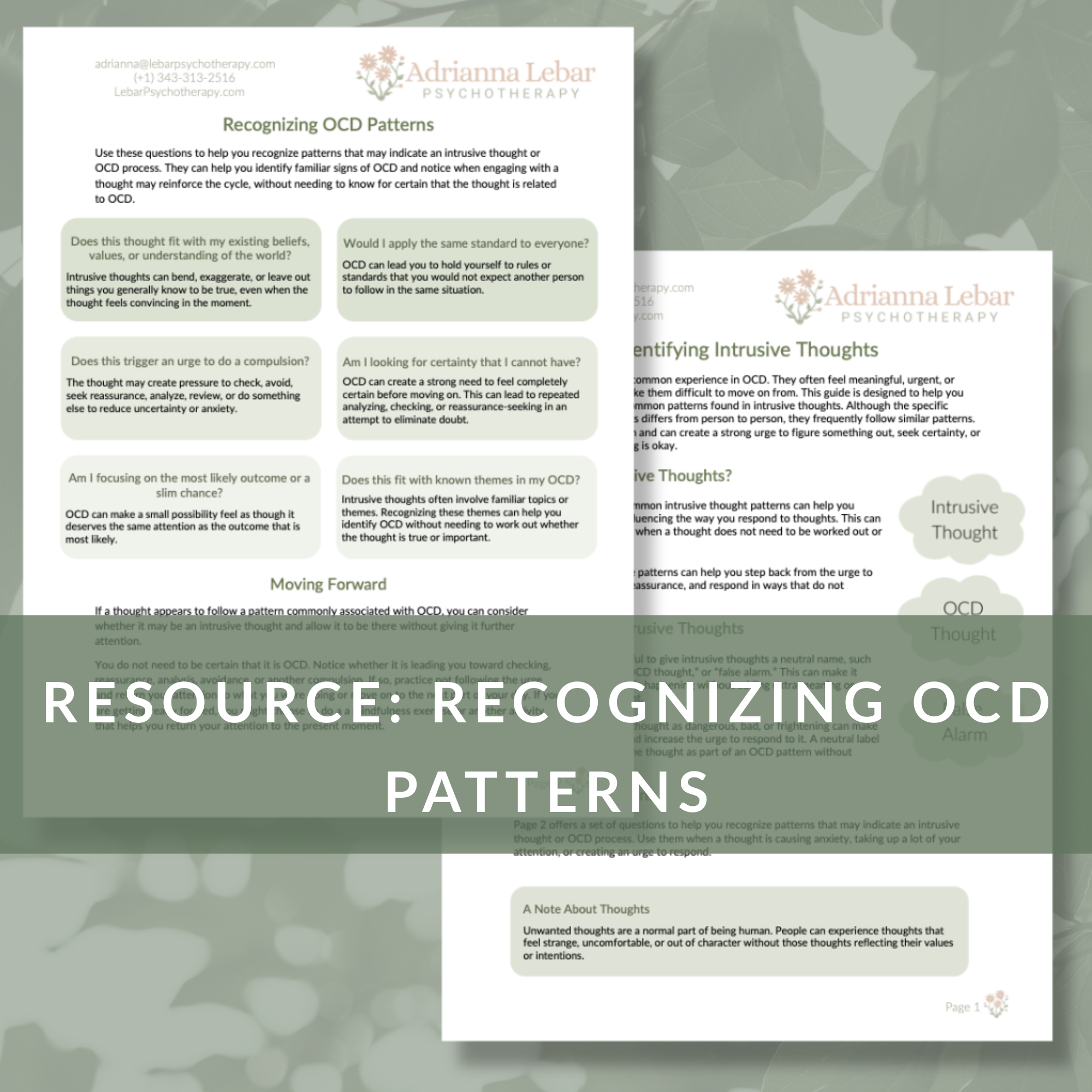
A printable resource for recognizing patterns that can occur around intrusive thoughts, uncertainty, and compulsive responses.
Our minds are constantly trying to make sense of what happens around us. When something feels uncertain or unresolved, it is natural to think about it and look for an answer. For those with OCD, this process can become difficult to step away from. A thought can take on a sense of importance or urgency, making it difficult to leave alone, even when thinking about it is no longer helpful.
Intrusive Thoughts Can Take Many Forms
Intrusive thoughts can take many forms and their content is often connected to the things that matter most to us. They may involve concerns about harm, responsibility, relationships, health, morality, mistakes, or other areas of life. The specific content can vary widely from person to person and it can change over time.
What can make an intrusive thought particularly difficult is not necessarily the subject matter itself but the sense that the thought is important and needs to be addressed. A person may feel compelled to respond because the thought creates a strong sense that something needs to be checked, avoided, understood, or resolved. It can be helpful to recognize intrusive thoughts as part of a broader pattern rather than focusing only on their specific content.
Understanding the Urge to Engage in a Compulsion
When an intrusive thought arises, you may notice a strong urge to do something in response. You might feel pulled toward checking, seeking reassurance, avoiding something, or engaging in another compulsion to reduce the discomfort the thought creates. The urge can feel immediate and difficult to resist, particularly when acting on it seems like the quickest way to feel better.
Noticing an intrusive thought in the moment can create an opportunity to pause and recognize the urge before acting on it. Instead of treating the thought as a problem that needs to be solved, you can begin to recognize it as part of an OCD pattern. With practice, you can learn to allow intrusive thoughts to be present without automatically engaging in a compulsion. Over time, this can help weaken the cycle of OCD.
Using the Reference Sheet
The Identifying Intrusive Thoughts resource can be used as a quick reference when you notice a thought that feels particularly urgent, distressing, or difficult to move away from. It provides a way to review common OCD patterns and consider whether they may be showing up in your own experience.
Educational Use and Scope
This reference sheet is intended as a psychoeducational resource and is best used alongside therapy.
Further Reading and Resources
The following resources provide further reading on intrusive thoughts, compulsive responses, and uncertainty in OCD. They offer additional information about how intrusive thoughts can become part of OCD patterns and the evidence base for understanding and responding to these experiences.
Audet, J., Bourguignon, L., & Aardema, F. (2023). What makes an obsession? A systematic‐review and meta‐analysis on the specific characteristics of intrusive cognitions in OCD in comparison with other clinical and non‐clinical populations. Clinical Psychology and Psychotherapy, 30(6), 1446–1463. https://doi.org/10.1002/cpp.2887
Ong, C. W., Blakey, S. M., Smith, B. M., Morrison, K. L., Bluett, E. J., Abramowitz, J. S., & Twohig, M. P. (2020). Moderators and processes of change in traditional exposure and response prevention (ERP) versus acceptance and commitment therapy-informed ERP for obsessive-compulsive disorder. Journal of Obsessive-Compulsive and Related Disorders, 24, Article 100499. https://doi.org/10.1016/j.jocrd.2019.100499
Knowles, K. A., & Olatunji, B. O. (2023). Intolerance of Uncertainty as a Cognitive Vulnerability for Obsessive-Compulsive Disorder: A Qualitative Review. Clinical Psychology (New York, N.Y.), 30(3), 317–330. https://doi.org/10.1037/cps0000150