

Mindful Noticing: A Simple ACT Exercise for Building Awareness
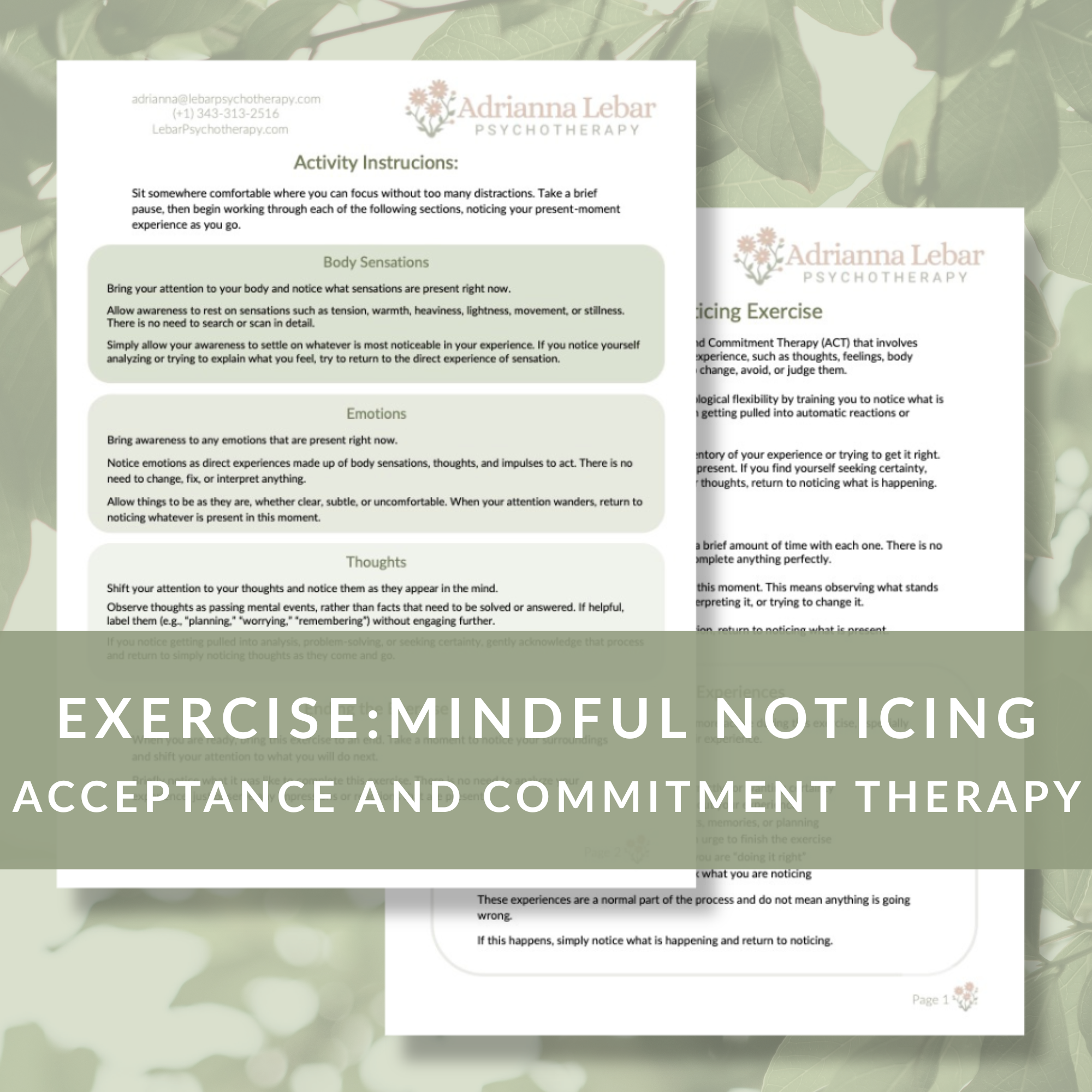
A printable resource for practicing mindful noticing and present-moment awareness.
This worksheet introduces mindful noticing, a practice commonly used in Acceptance and Commitment Therapy (ACT) and other mindfulness-based approaches. It offers a simple structure for observing thoughts, emotions, and body sensations as they are, without getting caught up in evaluating, interpreting, or trying to change them.
What Is Mindful Noticing?
Mindful noticing involves intentionally bringing attention to present-moment experiences. The emphasis is not on achieving a particular state or having a certain type of experience. Instead, the practice consists of observing whatever is occurring as it unfolds, moment by moment, without shifting into analysis, interpretation, or recollection.
What Mindful Noticing Is Not
When people first encounter mindfulness exercises, it is common to assume that the goal is to relax, clear the mind, or stop thinking. Mindful noticing is not about eliminating thoughts or creating a calm mental state. It is also not about analyzing experiences, finding deeper meaning, or determining whether you are doing the exercise correctly.
Thoughts may continue to appear. You may notice discomfort, distraction, or uncertainty. None of these experiences indicate that the exercise is working or not working. The practice remains the same: noticing what is present and returning attention to the moment whenever you realize your mind has wandered elsewhere.
What People Often Notice During the Exercise
Many people find that their mind seems especially busy when they begin paying close attention to what is happening in the present moment. These experiences are not obstacles to the exercise and can be included as part of what is being noticed.
It is common to notice:
Thoughts about whether you are doing the exercise correctly
Analysis or attempts to figure things out
Planning, remembering, or problem-solving
Restlessness or boredom
An urge to check, interpret, or evaluate what you are noticing
Uncertainty about what should be happening
How to Use This Worksheet in Session
This exercise can be introduced when clients are learning to become more aware of their internal experiences without immediately reacting to them. The worksheet provides a simple structure for bringing attention to different aspects of present-moment experience, including body sensations, emotions, and thoughts.
As they move through the exercise, the focus is on noticing what is present, recognizing when attention has drifted, and gently returning awareness to the current moment. Some people find the exercise straightforward, while others find it challenging. Both experiences are common and can provide opportunities for practice.
It is important to note that this worksheet provides a non-exhaustive list of areas to explore during a mindful noticing exercise. If following the worksheet in order feels too structured, you are always welcome to move between sections in whatever order feels most natural, or simply notice whatever comes to the forefront of your awareness from moment to moment. You may also choose to include experiences that are not listed on the worksheet, such as environmental sounds or other aspects of your surroundings, if doing so feels helpful.
A Note on Practice
Mindful noticing is an ongoing practice. Like many mindfulness skills, it develops through repeated attention and returning to awareness over time. Some days, a person may notice many thoughts and feel engaged with the exercise, where on other days, their attention may wander frequently. Rather than evaluating these experiences, the practice involves repeatedly returning attention to present-moment awareness, noticing thoughts, sensations, emotions, and surroundings as they arise.
Educational Use and Scope
This worksheet is intended as a general educational resource and a support alongside therapy.
Further Reading and Resources
These articles summarize current research on mindfulness and Acceptance and Commitment Therapy (ACT), with a focus on psychological flexibility and related processes such as decentering and present-moment awareness.
Macri, J. A., & Rogge, R. D. (2024). Examining domains of psychological flexibility and inflexibility as treatment mechanisms in acceptance and commitment therapy: A comprehensive systematic and meta-analytic review. Clinical Psychology Review, 110, Article 102432. https://doi.org/10.1016/j.cpr.2024.102432
Guo, L. (2024). The Correlation Between Mindfulness, Decentering, and Psychological Problems: A Structural Equation Modeling Meta-Analysis. Mindfulness, 15(8), 1873–1895. https://doi.org/10.1007/s12671-024-02395-6
Gloster, A. T., Walder, N., Levin, M. E., Twohig, M. P., & Karekla, M. (2020). The empirical status of acceptance and commitment therapy: A review of meta-analyses. Journal of Contextual Behavioral Science, 18, 181–192. https://doi.org/10.1016/j.jcbs.2020.09.009