

Non-Engagement Responses for Rumination (Mental Compulsions in OCD)
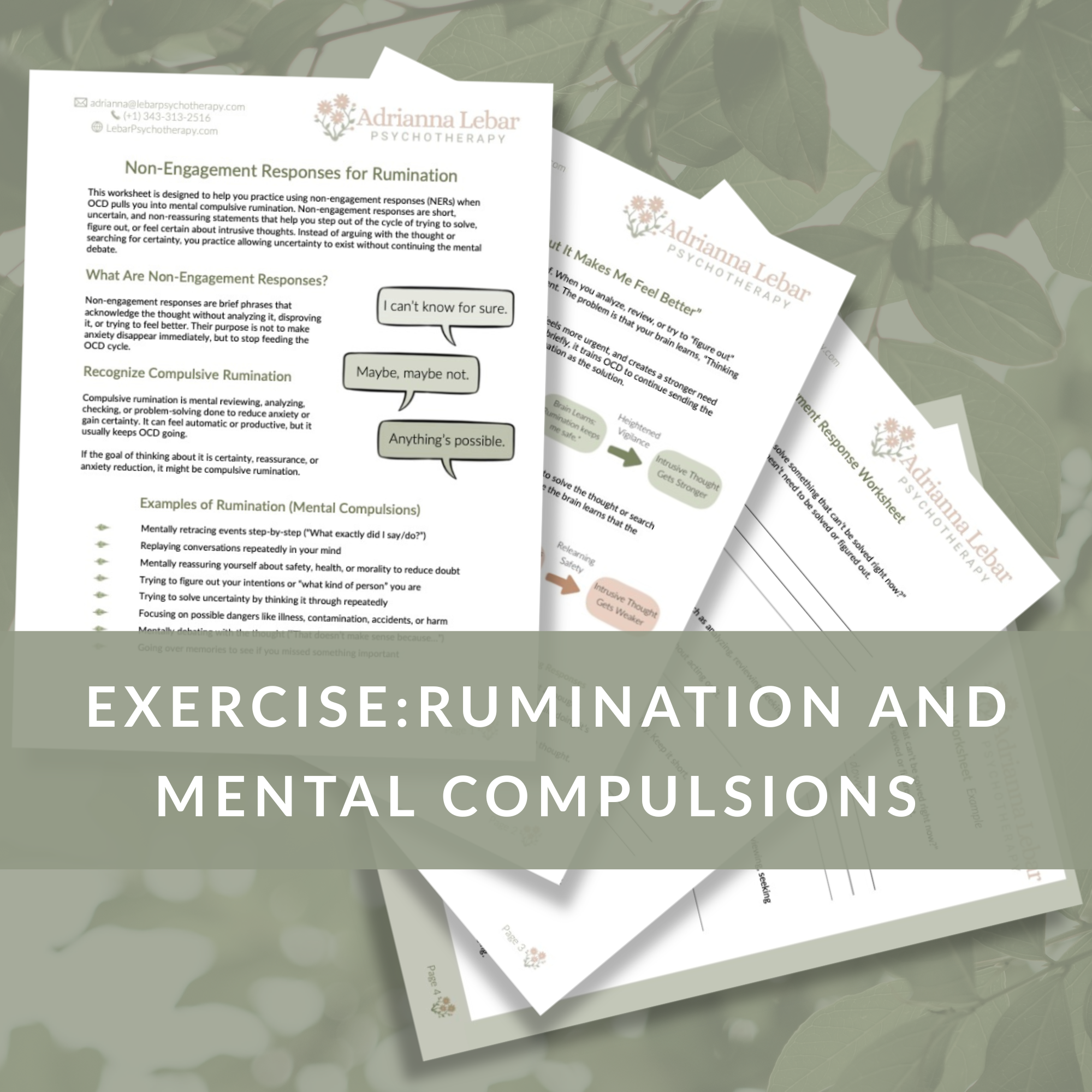
A printable resource for working with rumination and non-engagement responses for Obsessive Compulsive Disorder.
This worksheet is intended for clients who experience Obsessive Compulsive Disorder (OCD), anxiety, and intrusive thoughts, particularly when they get stuck in rumination or other mental compulsions. It is especially helpful in Exposure and Response Prevention (ERP) work when focusing on internal rituals that are easy to miss in the moment. Rumination in OCD can show up as overthinking, analyzing, reviewing, or trying to get certainty about intrusive thoughts. As it all happens internally, many people do not immediately recognize it as a compulsion.
This worksheet introduces Non-Engagement Responses (NERs) as a simple way to begin dealing with rumination in the moment.
What Are Non-Engagement Responses?
Non-engagement responses are brief, non-reassuring statements that help break mental engagement with intrusive thoughts. NERs are used to interrupt the pattern of trying to solve, figure out, or get certainty about a thought. The focus is on stepping out of that process rather than answering or resolving the thought. NERs are not meant to change the content of the thought or make it feel better. They are meant to reduce the habit of responding to intrusive thoughts with analysis or reassurance.
Rumination as a Mental Compulsion
In OCD, rumination often resembles ‘thinking things through’, though the function is usually the same as other compulsions. It is an attempt to feel certain or get relief from doubt. Rumination can sometimes bring short term relief, but it tend to strengthen the OCD cycle over time by reinforcing the idea that intrusive thoughts need to be solved.
Common forms of rumination include:
Internally replaying conversations or situations
Mentally reviewing past actions for mistakes
Trying to figure out meaning, intention, or morality
Reassuring yourself internally
Running through “what if” scenarios
Why Use Non-Engagement Responses
Mental compulsions can be difficult to notice, yet they play a significant role in maintaining the OCD cycle because they can be performed at any time and in almost any situation. As a result, people may continue engaging in compulsive responses even when overt behaviours have been reduced, limiting the effectiveness of treatment unless these mental rituals are also addressed.
NERs help interrupt mental compulsions by:
Reducing reassurance seeking and mental checking
Building tolerance for uncertainty
Interrupting rumination loops as they occur
Supporting a return to whatever the person was doing before the spiral
How This Worksheet is Used in Session
This worksheet can be introduced when clients begin to recognize rumination but feel unsure about how to respond to it. Many people believe they need to force ruminative thoughts away, or view the urge to ruminate as a sign that they are doing something wrong. This worksheet helps clients shift their focus from trying to control their thoughts to changing how they respond to them. In session, this often begins with completing the activity together to practice using NERs and to address common misconceptions about how they work.
If clients frequently find themselves ruminating before bed and have difficulty with the final step of the activity (Gently return to what you were doing), it can be helpful to offer a mindful noticing exercise as an alternative. This can help interrupt rumination, shift attention to the present moment, and support the transition to sleep.
A Note on Practice
When discussing NERs with clients, it is important to emphasize that shifting attention away from rumination is a skill that develops through practice rather than a technique that produces immediate change. With consistent use, clients may find themselves becoming less inclined to engage in rumination, which can help weaken the OCD cycle over time.
Educational Use and Scope
This worksheet is intended as a general educational resource and a support alongside therapy.
Further Reading and Resources
The following resources provide further reading on OCD, rumination, and ERP. They highlight some of the research and clinical literature that underpins the evidence-based approaches referenced throughout this worksheet.
Song, Y., Li, D., Zhang, S., Jin, Z., Zhen, Y., Su, Y., Zhang, M., Lu, L., Xue, X., Luo, J., Liang, M., & Li, X. (2022). The effect of exposure and response prevention therapy on obsessive-compulsive disorder: A systematic review and meta-analysis. Psychiatry Research, 317, Article 114861. https://doi.org/10.1016/j.psychres.2022.114861
Wahl, K., Kollárik, M., Heinzel, C. V., Koch, S., Voderholzer, U., & Lieb, R. (2024). Toward a Better Understanding of Who Is Likely to Be Susceptible to the Effects of Rumination on Obsessive–Compulsive Symptoms: An Explorative Analysis. International Journal of Cognitive Therapy, 17(4), 946–966. https://doi.org/10.1007/s41811-024-00228-x
Elsner, B., Jacobi, T., Kischkel, E., Schulze, D., & Reuter, B. (2022). Mechanisms of exposure and response prevention in obsessive-compulsive disorder: effects of habituation and expectancy violation on short-term outcome in cognitive behavioral therapy. BMC Psychiatry, 22(1), Article 66. https://doi.org/10.1186/s12888-022-03701-z